
DSMC-Neutrals Case Study - HDD Head Simulation
DSMC-Neutrals is a 3D rarefied gas analysis software package that utilizes the Direct Simulation Monte Carlo (DSMC) method. By employing an unstructured mesh, it enables simulations of complex geometries. It also supports chemical reaction calculations, making it suitable not only for simulating rarefied gas flows within vacuum chambers but also for modeling thin-film deposition in semiconductor manufacturing processes such as Chemical Vapor Deposition (CVD). If reading this article has made you even slightly interested in rarefied gas analysis or gas flow simulation, please feel free to contact us at any time to request materials or for further information.
Narrow Flow beside HDD Simulation
This is a three-dimensional simulation of gas flow between the hard disk head and the rotating disk.
Although it is generally difficult to use the DSMC method in regions of high pressure, calculations are possible when the computational domain is small.
Furthermore, the distance between the hard disk and the head is less than 0.1 μm in some locations, which is smaller than the mean free path of air.
Therefore, the DSMC method yields more accurate results than the continuum approximation.
The following describes the simulation of gas flow between the hard disk and the head.
The figure below shows a schematic diagram of a hard disk.
The actual computational domain is the area around the head at the tip of the slider.
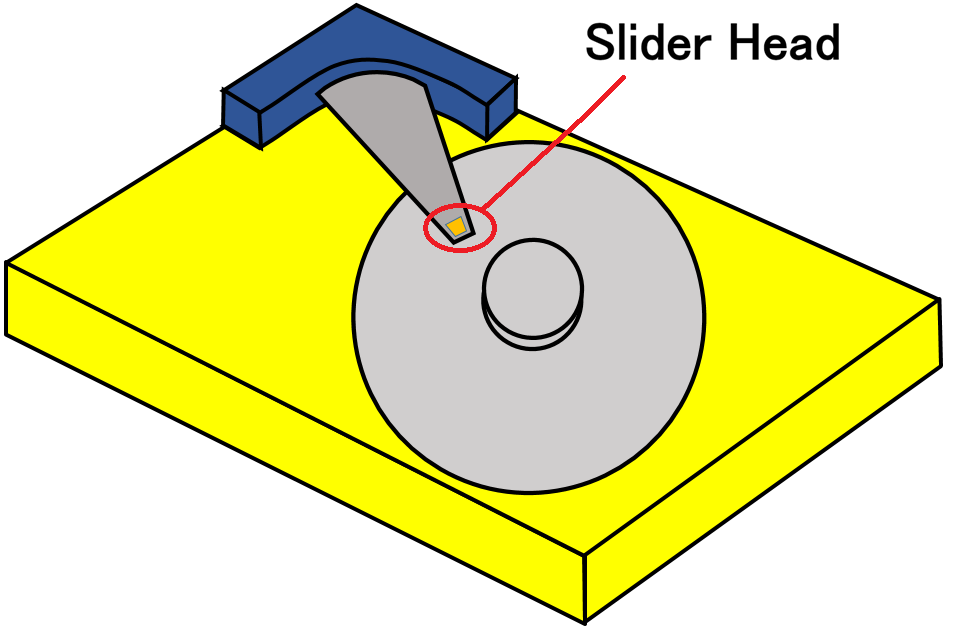
▲ Schematic Diagram of a Hard Disk
The figure below shows the computational domain and its dimensions. The computational domain is located between the disk and the head. Because the gap between the disk and the head is extremely narrow, the vertical scale in the figure has been magnified 100 times relative to the actual size.
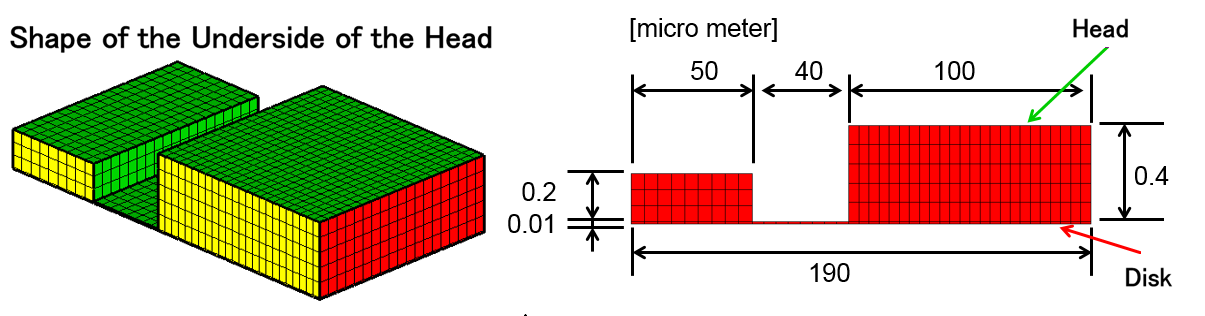
▲ Computational Domain (between the Disk and the Head)
The calculation conditions are shown below. In the calculation shown in the figure below, we calculate the force acting on the head when the head is 4 cm away from the center of the disk at a rotational speed of 5400 rpm. Under the above rotational speed conditions, the relative velocity between the disk and the head is 22.6 m/s. Therefore, we assumed that the disk surface velocity is 22.6 m/s and the flow velocity approaching the head from the front is also 22.6 m/s.
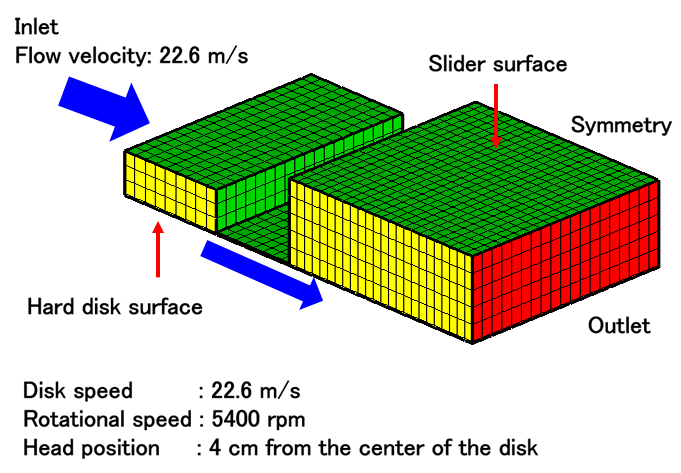
▲ Computational Domain and Boundary Conditions
The figure below shows the pressure distribution between the disk and the head. It can be seen that the pressure is lower near the edge of the head because air flows out of the gap.
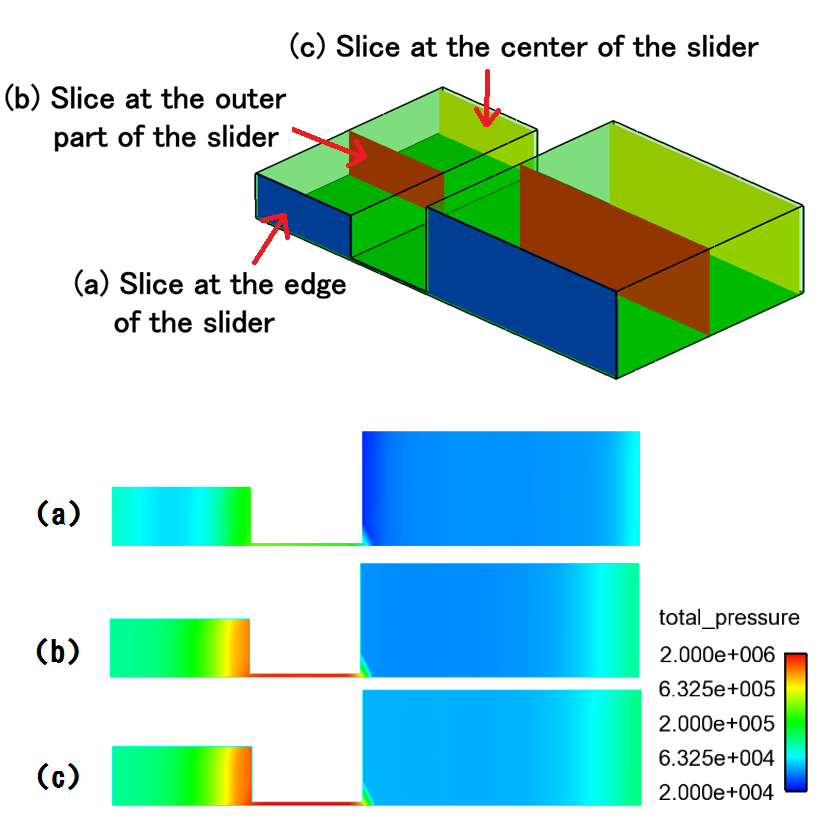
▲ Pressure Distribution between the Disk and the Head
The figure below shows the pressure distribution on the head surface. In DSMC-Neutrals, the surface pressure distribution is calculated directly from the impulse exerted by each particle upon collision with the wall.
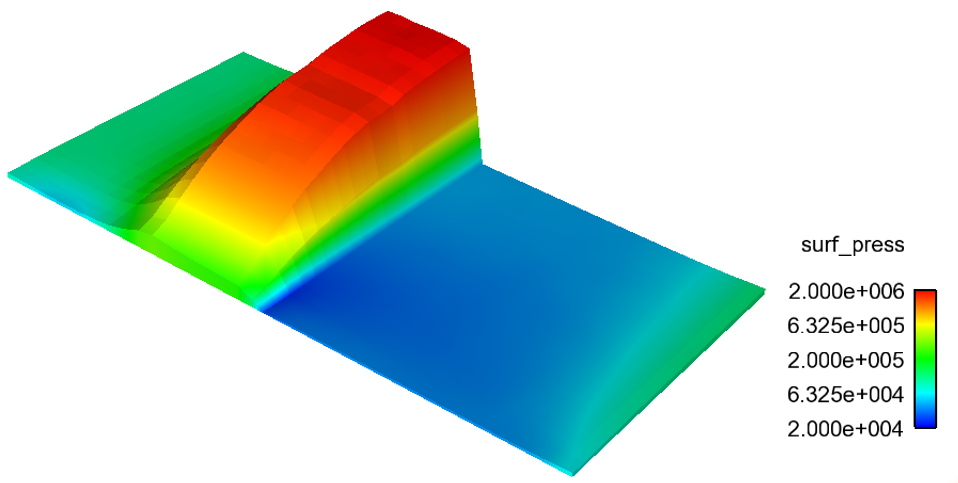
▲ Pressure Distribution on the Head Surface