
DSMC-Neutrals Case Study - Hypersonic Rarefied Flow Simulation
DSMC-Neutrals is a 3D rarefied gas analysis software package that utilizes the Direct Simulation Monte Carlo (DSMC) method. By employing an unstructured mesh, it enables simulations of complex geometries. It also supports chemical reaction calculations, making it suitable not only for simulating rarefied gas flows within vacuum chambers but also for modeling thin-film deposition in semiconductor manufacturing processes such as Chemical Vapor Deposition (CVD). If reading this article has made you even slightly interested in rarefied gas analysis or gas flow simulation, please feel free to contact us at any time to request materials or for further information.
Hypersonic Rarefied Flow Simulation
The following shows a simulation of hypersonic rarified flow analysis. The flow velocity is 7.5 km/s, which is 20 times the speed of sound. The chemical reaction calculations take into account the dissociation, recombination, and atomic exchange reactions of nitrogen and oxygen. It can be seen that most of the oxygen has dissociated due to the extremely high temperature on the object’s surface. DSMC-Neutrals is capable of reproducing hypersonic gas flows that cannot be calculated using standard fluid dynamics analysis software. Furthermore, the results from DSMC-Neutrals closely match those reported by Dogra et al. [1].
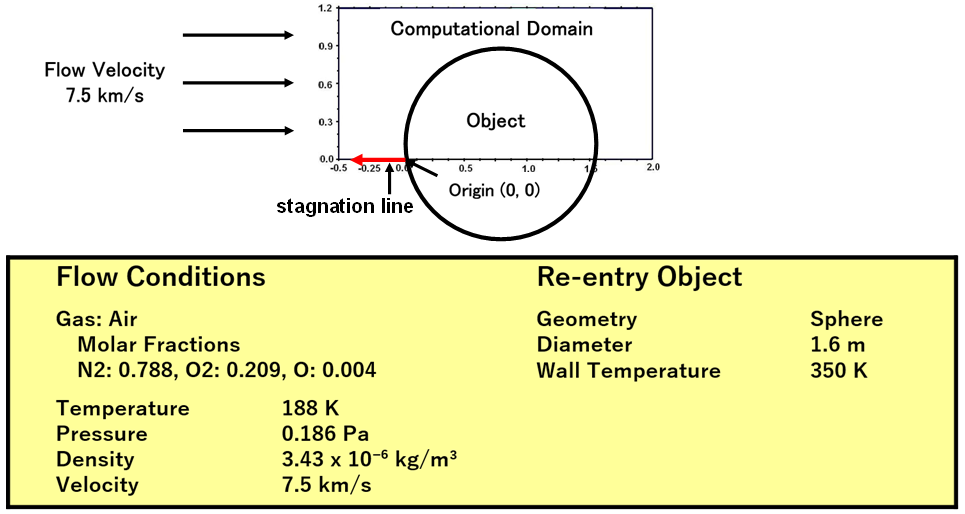
▲ Computational Domain and Boundary Conditions
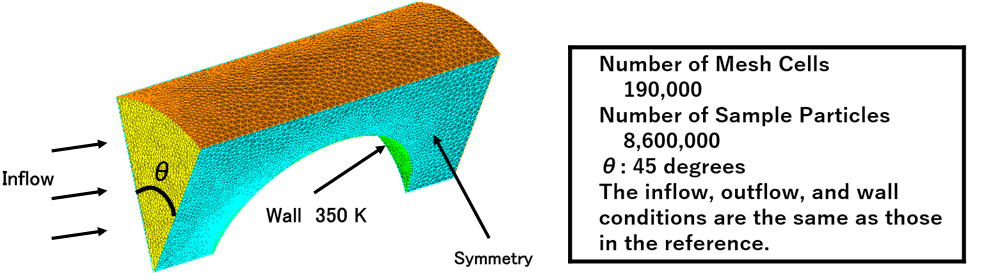
▲ Model Geometry and Mesh
Collision Model
- Elastic Collision
-
Variable Hard Sphere (VHS) model using null-collision method
- Inelastic Collision
- Rotation
Calculated using the elimination method based on the Larsen-Bolgnakke distribution function.
Degrees of freedom for N2 and O2 : $2$
Relaxation value $Zr$ : $5$
- Vibration
Calculated using the exclusion method based on the quantized Larsen-Bolgnakke distribution function.
The relaxation value $Z_v$ is calculated using the following equation: \begin{align*} Z_v = ( C_1 / T^w ) e^{C_2 T^{-1/3}} \end{align*} Here, the constants $C_1$ and $C_2$ are species-dependent constants.
- Rotation
Chemical Reaction Model
Total Collision Energy (TCE) model calculating collision probabilities based on total collision energy and the constants of the Arrhenius equation
- Chemical equation
N2 + M <---> N + N + M
O2 + M <---> O + O + M
NO + M <---> N + O + M
M is the third body particle. - Exchange
- Chemical equation
NO + O <---> N + O2
N2 + O <---> N + NO
- Chemical equation
Results
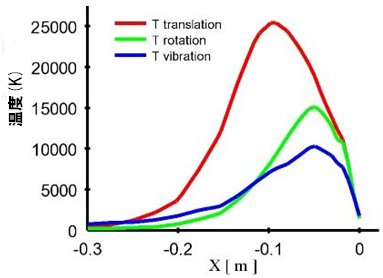
The results obtained using DSMC-Neutrals are shown below. Although the mesh and detailed configuration parameters used may differ from those in the reference, the results from DSMC-Neutrals reproduce the results presented there.
.png)
▲ Particle density distribution
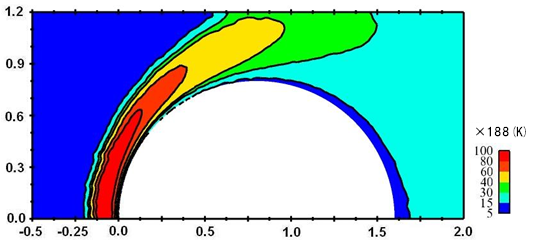
▲ Average Temperature Distribution
 |
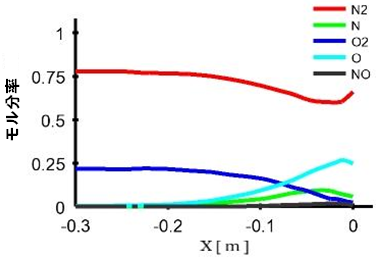 |
Results. (Left) Translation, rotation, and vibration temperatures on the stagnation line. (Right) Molar fractions on the stagnation line.
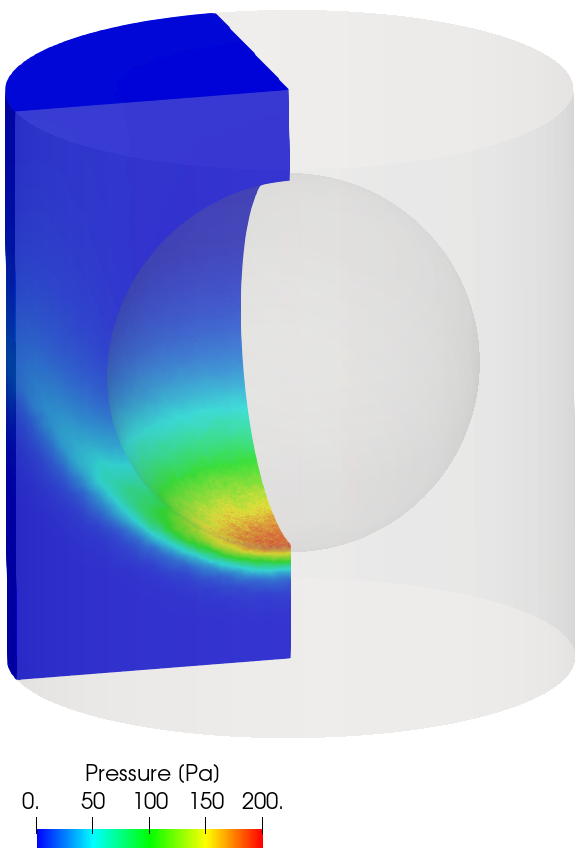
▲ Adiabatic Compression by Hypersonic Rarefied Flow in Atmospheric Entry of Sphere Object
Reference
-
[1] Dogra V. K., Wilmoth R. G., and Moss J. N., AIAA Journal, Vol. 30, No.7, 1789-1794 (1992),
https://arc.aiaa.org/doi/10.2514/3.10729
